

That oily film floating on top of your coffee? It's not just an aesthetic problem. If you've ever blended raw MCT oil or spooned in coconut oil only to end up with a greasy, separated mess, you already know that the MCT oil vs coconut oil in coffee debate isn't just about which fat is "healthier." It's about what actually works in your cup, in your body, and in your morning.
You're right to want more from your first sip. The idea of a fat-fueled coffee ritual that delivers clean, lasting energy without the mid-morning crash is completely worth pursuing. The confusion usually comes down to one thing: these two oils are not the same, and treating them like they are is exactly why so many people end up with digestive discomfort, a ruined cup, and more questions than answers.
Here's what this guide will do for you. We'll break down the real metabolic differences between MCT oil and coconut oil, explain why your body responds to each one differently, and show you how to build a creamy, satisfying morning ritual that actually holds together, without the mess, the guesswork, or the junk ingredients.
Key Takeaways
- The MCT oil vs coconut oil in coffee debate comes down to more than health claims — metabolic speed, emulsification, and ingredient integrity all determine which fat actually works for your morning ritual.
- MCTs and coconut oil behave differently in your body and in your cup, and understanding that difference is the key to getting clean, lasting energy without the crash or the oil slick.
- Hidden sugars and fillers like maltodextrin can quietly undermine even the most carefully chosen healthy fats — your label literacy matters as much as your oil choice.
- The biggest practical barrier to a fat-fueled coffee ritual isn't which oil you pick — it's the emulsification problem, and there's a smarter, simpler solution than reaching for the blender every morning.
- Powdered creamers built on clean, glucose-friendly ingredients are quietly replacing the bottle of oil on the counter — and once you understand why, you won't look at your morning routine the same way again.
Understanding the Basics: What are MCTs and Coconut Oil?
Before you can make a confident choice in the MCT oil vs coconut oil in coffee debate, you need to understand what you're actually working with. These aren't interchangeable products with different labels. They're fundamentally different fats, processed differently by your body, and they behave differently in your cup.
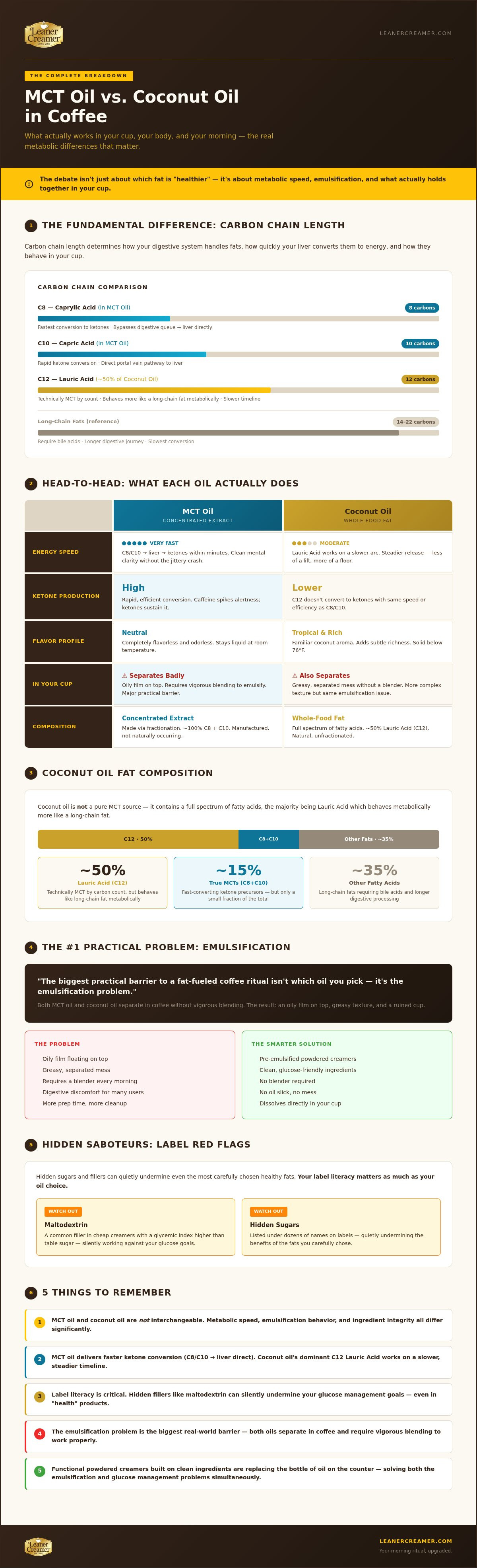
The key to understanding both comes down to a single concept: carbon chain length. Dietary fats are classified by how many carbon atoms link together in their molecular structure. That number determines how your digestive system handles them, how quickly your liver converts them to energy, and how they interact with everything else in your morning ritual.
Medium-chain triglycerides sit in a specific range of six to twelve carbon atoms. What makes them genuinely interesting isn't the number itself. It's what that length means for your metabolism.
MCT Oil: The Concentrated Extract
MCT oil doesn't exist in nature the way you'd find it in a jar on a grocery shelf. It's manufactured through a process called fractionation, where specific fatty acids are isolated and extracted from coconut or palm kernel oil. The result is a purified, concentrated oil that's almost entirely composed of two fatty acids: C8 (Caprylic Acid) and C10 (Capric Acid).
These shorter chains are the reason MCT oil has earned its reputation for fast energy. Unlike long-chain fats that require bile acids and a longer digestive journey, C8 and C10 travel directly to the liver via the portal vein, where they're rapidly converted into ketones. That's usable fuel, available quickly, without the processing detour.
Because fractionation removes the heavier compounds, pure MCT oil is completely flavorless, odorless, and stays liquid at room temperature. That neutrality makes it appealing for coffee, but it also creates a practical problem we'll get into shortly.
Coconut Oil: The Holistic Fat
Coconut oil is a whole-food fat, and that distinction matters. It contains a full spectrum of fatty acids, not just the medium-chain ones. The dominant fatty acid in coconut oil is Lauric Acid, or C12, which accounts for roughly 50% of its total fat content.
Here's where the classification gets complicated. Technically, C12 qualifies as a medium-chain triglyceride by carbon count. But metabolically, it behaves more like a long-chain fat. Lauric Acid requires more digestive processing and doesn't convert to ketones with the same speed or efficiency as C8 or C10. It's still a beneficial fat, but it's working on a different timeline.
Coconut oil also brings sensory qualities that MCT oil simply doesn't have. That familiar tropical aroma, the solid-to-liquid transition around 76°F, the subtle richness it adds to a cup. These characteristics make it a more textured, complex ingredient, which is exactly why understanding the MCT oil vs coconut oil in coffee difference shapes not just your health outcomes, but your entire sensory experience.
MCT Oil vs. Coconut Oil: Comparing Benefits for Coffee
Knowing what these fats are is only half the picture. The more useful question is what they actually do once they're in your cup and in your body. And here's where the MCT oil vs coconut oil in coffee comparison gets genuinely interesting, because the differences aren't subtle.
Energy and Mental Performance
MCT oil has earned its reputation among biohackers and keto enthusiasts for a specific reason: speed. Because C8 and C10 fatty acids convert to ketones so rapidly, your brain gets access to a clean, efficient fuel source within a relatively short window after consumption. That's not marketing language. It's a reflection of how those shorter carbon chains bypass the digestive queue and head straight to the liver.
The post-coffee sensation that MCT oil users describe isn't just a caffeine response. It's a particular kind of mental sharpness, a quiet clarity that settles in without the jittery edge that often follows a strong cup on an empty stomach. Caffeine spikes your alertness; ketones sustain it. That combination is why fat-fueled coffee became a morning ritual in the first place.
Coconut oil works on a slower arc. Its Lauric Acid content still contributes to energy production, but the timeline is more gradual. For some people, that steadier release feels more grounding. Less of a lift, more of a floor.
Metabolic Health and Satiety
Here's something most comparisons miss entirely: the appetite dimension. Adding healthy fat to your morning coffee doesn't just change your energy curve. It changes your hunger signals. Fat slows gastric emptying, which means your body registers fullness longer and your blood sugar stays more stable than it would after a carbohydrate-heavy breakfast.
That "satiety signal" is why people who add fat to their coffee often find themselves genuinely not hungry until midday. No mid-morning snack raid. No 10 a.m. focus crash. Just a longer, more even stretch of productive hours.
Both oils contribute to this effect, but they bring different secondary benefits:
- MCT oil has a mild thermogenic effect, meaning it may support calorie burning slightly more than longer-chain fats, though the magnitude is modest and individual results vary.
- Coconut oil brings Lauric Acid's well-documented antimicrobial properties, which support gut health as part of a broader wellness routine.
- Both fats help buffer the stimulant effect of caffeine, smoothing out the spike-and-crash cycle that makes black coffee feel unsustainable for many people.
The practical takeaway is that neither fat is universally "better." They serve different priorities. If rapid cognitive fuel is your goal, MCT oil leads. If you want a more holistic fat profile with additional gut-supportive benefits, coconut oil earns its place. If you want both without the blender and the oil slick, a clean powdered creamer built on these ingredients is worth a serious look.
The Practical Reality: Texture, Taste, and the Oil Slick
You've read about the metabolic benefits. You're sold on the concept. So you pour a tablespoon of MCT oil into your morning brew, give it a quick stir, and take a sip. What you get isn't a creamy, energizing ritual. It's a greasy mouthful with a slick film floating on top and an oily residue coating your lips. Sound familiar?
This is the part that most guides skip entirely. And it's exactly why so many people try fat-fueled coffee once and never go back.
The Emulsification Challenge
Oil and water don't mix. That's not a preference; it's chemistry. Coffee is water-based, and without a binding agent to bridge the two, any oil you add will separate and rise to the surface. A spoon doesn't solve this. Vigorous stirring buys you about thirty seconds of integration before the film reforms. What you need is emulsification, the process of breaking fat into microscopic droplets that disperse evenly through a liquid and stay there.
The difference between an oily coffee and a genuinely frothy, latte-like cup comes down to this single step. A high-speed blender achieves it reliably. Thirty to sixty seconds of blending creates a stable emulsion, producing that velvety texture that makes fat-fueled coffee worth the effort. The practical downsides are real: a hot blender lid that requires careful handling, extra cleanup, and a noise level that doesn't always suit a quiet morning. It works, but it's not exactly seamless.
Sensory Experience and Ritual
Flavor matters more than most health content admits. In the MCT oil vs coconut oil in coffee comparison, the sensory gap between these two fats is significant. MCT oil is completely neutral. No aroma, no taste. It adds nothing to your cup except its functional properties, which makes it forgiving but also flat. Coconut oil brings warmth. That faint tropical note, the subtle richness, the way it rounds out a dark roast without overwhelming it.
First-timers often describe fat-added coffee as "heavy" or "greasy," and that's almost always an emulsification failure, not a fat problem. A properly blended cup feels smooth and satisfying, not coating. The fat should dissolve into the experience, not announce itself.
Digestive tolerance is the other reality nobody warns you about. Both MCT oil and coconut oil can cause significant GI distress when introduced too quickly, especially on an empty stomach. Starting with a small amount, closer to a teaspoon than a tablespoon, and building gradually over a week or two isn't optional advice. It's the difference between a ritual you stick with and one you abandon after a bad Tuesday morning.
The good news? The emulsification problem has a cleaner solution than a blender on the counter. Powdered creamers built on coconut oil and MCT sources solve the texture issue by design. The fat is already integrated into a format that disperses evenly in hot liquid, no blending required. That's not a workaround. It's the MCT oil vs coconut oil in coffee ritual, finally made practical.
Glucose Management and the Clean Label Choice
You've chosen a healthy fat. You've committed to the ritual. And then you flip the label on that "keto-friendly" flavored creamer or coconut oil blend and find maltodextrin sitting quietly in the ingredient list. That one ingredient can unravel everything you're trying to build.
This is the part of the MCT oil vs coconut oil in coffee conversation that most guides skip entirely. The fat itself isn't the only variable. What's sitting next to it in the formula matters just as much, and sometimes more.
Avoiding the Sugar Trap
Maltodextrin is a processed starch derived from corn, rice, or wheat. It's used as a filler and flow agent in powdered products, and it has a glycemic index higher than table sugar. That means it triggers an insulin response, quietly, even when a product is marketed as sugar-free or keto. Artificial sweeteners present a similar concern for many people, with some research suggesting they can still affect insulin signaling even without contributing calories.
Reading a label isn't paranoia. It's self-respect. The ingredients to watch for include:
- Maltodextrin — a high-glycemic filler that undermines blood sugar stability
- Artificial sweeteners like acesulfame potassium or sucralose, which may affect insulin response in sensitive individuals
- Hydrogenated oils — a red flag in any product claiming to support metabolic health
- Casein — a dairy protein that excludes people with sensitivities, often hiding in "non-dairy" products
Clean label isn't a trend. It's a standard. Leaner Creamer's ingredient transparency page is exactly the kind of resource worth bookmarking before you commit to any morning ritual product, because knowing what's in your cup is non-negotiable.
The Holistic Wellness Perspective
Stable blood sugar isn't just a metabolic metric. It's a mood metric. When glucose levels spike and crash, the emotional fallout follows: irritability, low motivation, that hollow, restless feeling that makes a second cup feel necessary before noon. Protecting your blood sugar in the morning is one of the quietest, most effective things you can do for your emotional steadiness throughout the day.
That's the shift worth making: from "is this healthy?" to "how does this actually make me feel two hours from now?" Intentionality in your morning routine isn't a luxury. It's a form of care that compounds. When you know exactly what's in your cup, when there are no hidden fillers, no mystery sweeteners, no ingredients you'd have to look up, that certainty itself becomes part of the ritual.
A creamer built on coconut oil, MCT sources, and genuinely clean ingredients doesn't ask you to compromise between convenience and integrity. It offers both.
The Evolution of the Ritual: Functional Powdered Creamers
Think about what's sitting on your counter right now. A bottle of MCT oil. Maybe a jar of coconut oil. A blender you have to drag out every morning, fill, carefully lid, and then clean before your first cup is even finished. That's not a ritual. That's a project.
The MCT oil vs coconut oil in coffee conversation has always assumed you're working with raw oils and a willingness to troubleshoot. But the format itself has evolved, and the cleanest solution to the emulsification problem isn't a better blender technique. It's a smarter ingredient format entirely.
Why Powder Wins Over Oil
Powdered creamers built on coconut oil and MCT sources solve the oil-slick problem by design, not by workaround. The fat is already integrated into a dry matrix that disperses evenly the moment it hits hot liquid. No separation. No film. No thirty-second blending window before the texture collapses. Just a consistent, latte-like creaminess from the first stir to the last sip.
Portion control is the other practical win. Measuring a tablespoon of liquid oil is an exercise in patience and paper towels. One scoop of powder is exact, clean, and repeatable. The ritual stays simple. The counter stays clean. Explore new creamer options that bring this convenience without compromising on ingredients.
The format also travels. A small bag of powdered creamer fits in a gym bag alongside high-performance nutrition from Muscle Works, a carry-on, or a desk drawer. Your morning ritual doesn't have to disappear the moment you leave home.
Leaner Creamer: Your Mindful Coffee Partner
Leaner Creamer was built around a specific idea: that your daily cup deserves better than fillers, hidden sugars, and dairy derivatives dressed up in wellness language. Their MCT oil instant latte powder brings together the fast-fuel benefits of MCTs and the richness of coconut milk in a format that's dairy-free, gluten-free, and genuinely glucose-friendly. No maltodextrin. No casein. No ingredients that require a search engine to decode.
What that means in practice is a cup that tastes like something you'd pay for at a coffee shop, built on a foundation that actually supports how you want to feel two hours later. Focused. Even. Not chasing your next fix.
That's the shift worth making. From a messy, inconsistent experiment with raw oils to a clean, intentional scoop that delivers both benefits in one step.
Pure. Simple. Intentional.
Frequently Asked Questions
Is MCT oil better than coconut oil for weight loss in coffee?
MCT oil has a modest edge for weight loss specifically because C8 and C10 fatty acids convert to ketones quickly, which may support a mild thermogenic effect and more efficient fat metabolism compared to coconut oil's slower-acting Lauric Acid. That said, neither oil is a weight loss solution on its own. The more meaningful factor is what else is in your cup: hidden fillers like maltodextrin can quietly spike blood sugar and undermine any metabolic benefit either fat provides.
Can I put both MCT oil and coconut oil in my coffee?
Yes, and many people do. Combining them gives you the fast ketone conversion of MCT oil alongside the broader fat profile and natural richness of coconut oil. The practical challenge is that you're now managing two separate oils and a blender just to avoid an oil slick. A cleaner approach is a powdered creamer built on both coconut oil and MCT sources, which delivers the combined benefits in a single, mess-free scoop that disperses evenly without any extra equipment.
Does MCT oil in coffee break a fast?
Technically, yes. MCT oil contains calories, and consuming calories ends a true fast. However, many people practicing intermittent fasting choose to include MCT oil in their morning coffee because it doesn't trigger an insulin spike the way carbohydrates do, and it supports ketone production that aligns with their fasting goals. Whether it "breaks" your fast depends entirely on your fasting protocol and what you're optimizing for, so it's worth clarifying your specific approach before deciding.
How do I stop the oil from floating on top of my coffee?
The only reliable fix is emulsification. Stirring doesn't work; you need a high-speed blender running for thirty to sixty seconds to break the fat into droplets small enough to stay suspended in the liquid. That gives you a creamy, stable cup rather than an oily film. If that process feels like too much for a morning routine, a powdered creamer built on coconut oil or MCT sources solves the problem entirely, since the fat is already integrated into a format that disperses evenly the moment it hits hot liquid.
What are the side effects of putting MCT oil in my coffee?
The most common side effect is digestive discomfort, including nausea, cramping, or loose stools, particularly when you start with too much too soon or drink it on a completely empty stomach. Your gut needs time to adjust to concentrated MCTs. Starting with a half teaspoon and building gradually over one to two weeks significantly reduces the risk. Some people also notice a temporary energy intensity that feels different from caffeine, which settles as your body adapts to using ketones as fuel.
Is there a difference between MCT oil and liquid coconut oil?
Yes, and it's a meaningful one. MCT oil is a concentrated extract produced through fractionation, containing primarily C8 and C10 fatty acids with no Lauric Acid. Liquid coconut oil is simply regular coconut oil that's been processed or refined to remain liquid at room temperature, and it still contains the full fatty acid spectrum including roughly 50% Lauric Acid. They're not interchangeable. In the MCT oil vs coconut oil in coffee comparison, liquid coconut oil behaves metabolically more like standard coconut oil than like a true MCT concentrate.
Can I use coconut milk instead of coconut oil for the same benefits?
Coconut milk offers some overlap but it's a different product. It contains fat from coconut, but also water and sometimes additives, which means the fat concentration is considerably lower than coconut oil. You'd need a significant amount to approximate the same fat content, and the metabolic benefits scale with the fat dose. Coconut milk does add creaminess naturally, and some clean-label powdered latte mixes use coconut milk as a base ingredient, which gives you a more balanced, palatable cup without the concentrated fat of straight coconut oil.


