


What if “clean label” sounds reassuring but doesn’t tell you exactly what’s in the package? If you’ve wondered what is a clean label product, you’re not alone. The phrase appears on food packaging, yet it has no single official U.S. definition or universal certification. That can make ingredient lists feel harder to assess and marketing claims easier to mistake for verified standards.
It’s reasonable to want clear, recognizable information before choosing what becomes part of your routine. You don’t need to decode every unfamiliar ingredient at once or rely on a front-of-package promise. Reviewing the ingredient list, nutrition facts, and any specific certification gives you a more useful basis for comparison.
This guide explains what clean label can mean, how to read ingredient lists with more confidence, and which words on packaging deserve a closer look. You’ll also see how to apply the same practical approach to everyday coffee additions, including powdered creamers. The goal is a clearer decision based on the details that matter to you, not an absolute claim about what every product should be.
Key Takeaways
- Learn what is a clean label product without treating the phrase as a universal standard or certification.
- Look beyond ingredient count: familiarity, processing, and clear disclosure are different things to consider.
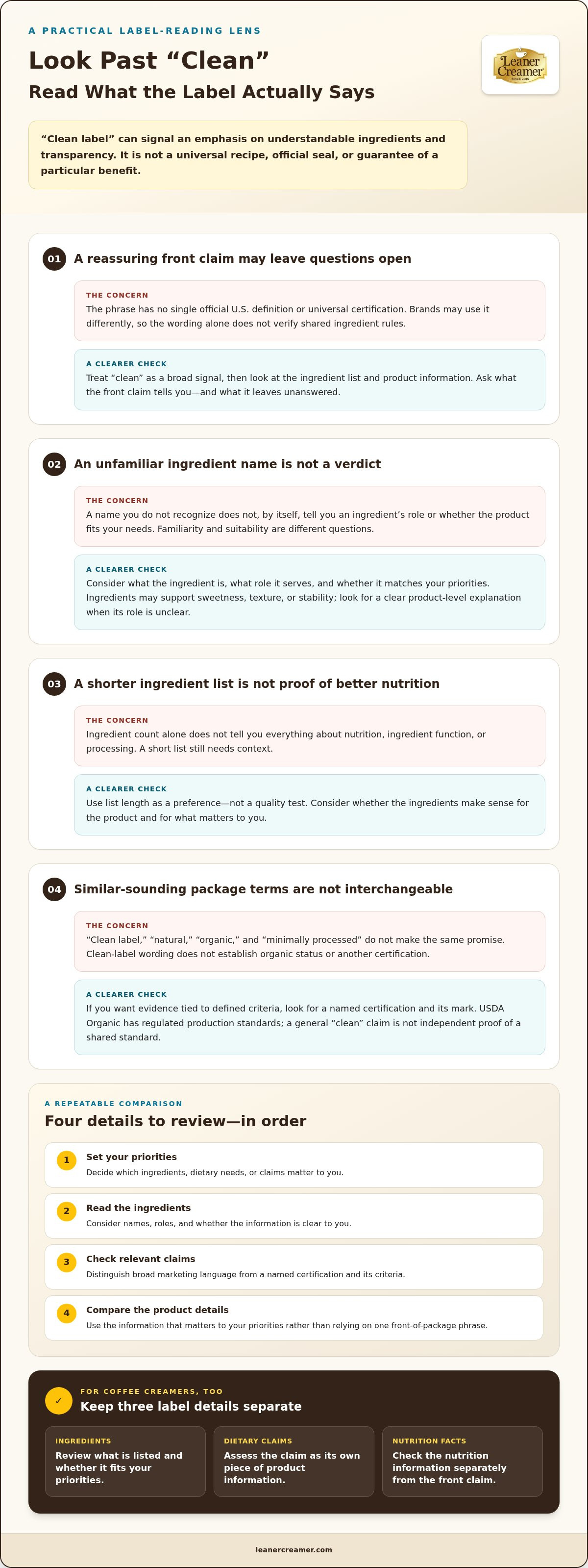
- Use a simple sequence when comparing products: set your priorities, read the ingredients, check relevant claims, then compare.
- Assess coffee creamers by their ingredient information, dietary claims, and nutrition facts as separate details.
- Create a short checklist for repeat purchases, and revisit the label when a product changes.
What Is a Clean Label Product, and Why Can the Term Feel Unclear?
Clean label generally signals an emphasis on understandable ingredients and transparency. So, what is a clean label product in practical terms? It’s a food product whose ingredients and product information are presented in a way shoppers may find clear and straightforward. There’s no single formula behind the phrase, however, and one brand’s idea of “clean” may differ from another’s.
Clean label describes an emphasis on understandable ingredients and transparent product information, not a standardized recipe, health outcome, or official seal. A package can use the phrase to describe a brand’s approach, but the words themselves don’t verify that a product meets shared ingredient rules. For background on the term’s development and consumer perceptions, see What is a Clean Label?
In the United States, as of October 2026, “clean label” has no official or legal definition from the FDA or another regulatory body. That doesn’t make the phrase meaningless. It means shoppers need to look at the information behind it rather than assume it guarantees a particular ingredient list, level of processing, or benefit.
Is clean label an official food certification?
No. Clean label is used differently across brands and food categories, and it isn’t a named certification with a universal checklist. A brand may use it to describe its approach to ingredients or disclosure. That’s voluntary marketing language, not independent proof that a product satisfies one shared standard.
Named certifications are different: each has its own criteria and scope. For example, USDA Organic is a regulated term with production standards, while a clean-label claim by itself doesn’t establish organic status or any other certification. Look for the certification’s name and mark, then distinguish that evidence from general wording such as “clean,” “simple,” or “natural.” The claim and the proof are not interchangeable.
What might shoppers mean by clean label?
For some shoppers, clean label means being able to recognize or understand the ingredients. Others may prioritize clear explanations of what ingredients do, specific dietary needs, or avoiding particular additives. These are personal criteria, not a universal definition. A shorter ingredient list may appeal to one person, while another may care more about a specific ingredient or claim.
It also helps to keep three ideas separate: an ingredient’s name, the clarity of its explanation, and whether it fits your preferences. An unfamiliar name isn’t automatically a sign of harm, just as a familiar ingredient doesn’t guarantee a product is higher quality. The label gives you information to consider, not a simple good-or-bad verdict.
- Ask what the front-of-package claim actually tells you, and what it leaves unanswered.
- Notice whether the brand explains its ingredient choices in clear, specific language.
- Look for a named certification if you want evidence tied to defined criteria.
A steadier way to read the phrase is to treat clean label as a broad signal of transparency, then assess the product details against your priorities. This can help you make an informed choice without expecting one undefined term to answer every question.
How Clean Label Language Relates to Ingredients, Processing, and Transparency
Ingredient transparency is about more than whether a label includes a list. It also means the information is presented clearly enough for you to understand what’s disclosed and, where possible, why an ingredient is there. When considering what is a clean label product, assess these details separately: the number of ingredients, how familiar their names are to you, and how the food is processed. None of those measures alone settles whether a product fits your preferences.
An ingredient may serve a practical purpose, such as adding sweetness, creating a particular texture, or supporting a product’s stability. Its presence doesn’t automatically make a product unsuitable. Consider what the ingredient is, what role it plays, and whether the product aligns with your needs. Michigan State University Extension discusses how clean-label language shapes shopper perception in Clean Label as a Marketing Term.
A short ingredient list, by itself, isn’t proof that a product is more healthful. It may be easier for some shoppers to scan, but list length doesn’t tell you everything about nutrition, ingredient function, or processing.
Does clean label mean fewer ingredients?
Some shoppers prefer shorter lists because they feel simpler to review. That preference can be useful, but it isn’t a universal quality test. A longer list may include ingredients that each serve a specific purpose, while a short list still needs to be understood in context. Rather than treating length as a verdict, consider whether the ingredients make sense for the product and your priorities.
For instance, sweetness, texture, and stability are different formulation needs. Seeing an ingredient with an unfamiliar name doesn’t explain its role or tell you whether it meets your needs. If the label doesn’t make that clear, look for a product-level explanation from the brand. Transparency is not just a short list; it’s useful information you can interpret.
Does clean label mean natural or minimally processed?
No. “Clean label,” “natural,” “organic,” and “minimally processed” are distinct descriptions, not interchangeable promises. Organic has defined USDA standards, while “natural” does not have a formal, binding FDA definition. Clean-label wording doesn’t establish either claim, and it doesn’t specify how much processing a food has undergone. Check each term separately instead of reading one as proof of another.
Processing also isn’t a standalone verdict on quality or safety. It describes how a food or ingredient has been handled or made, but the word alone doesn’t tell you whether the result suits your diet or preferences. A more grounded label check separates the questions:
- Ingredients: What’s listed, and can you understand its role?
- Nutrition: What does the nutrition information tell you about the product?
- Claims: Is a term supported by a named certification or specific product information?
This approach supports practical choices without chasing a single “perfect” list. For a familiar daily example, compare the ingredient information for powdered coffee creamers and other coffee additions with the details you personally care about.
How to Evaluate a Clean Label Product Without Relying on the Front-of-Pack Claim
A front-of-pack phrase can catch your eye, but the details that help you decide are elsewhere on the package. Instead of asking only whether a product is “clean,” use a repeatable check that starts with your priorities. This turns what is a clean label product into a practical shopping question: does the product’s information help you decide whether it suits your needs?
- Name your priorities. Decide what matters for this purchase, such as a dietary need, a particular ingredient, or a nutrient you want to monitor. Keep the list focused so you can compare products without trying to judge every detail at once.
- Read the ingredient list. Look for the ingredients relevant to your priorities. If a name is unfamiliar, don’t treat that alone as a verdict; look for a clear explanation of its role.
- Check nutrition information. Review serving size and the nutrients that matter to you. Nutrition facts and ingredient lists answer different questions, so one doesn’t replace the other.
- Review claims, then compare. Separate dietary claims, named certifications, and a brand’s clean-label positioning. Each describes something different, so don’t assume one claim proves another.
Which parts of a product label should you read first?
Start with the ingredient list and note anything that connects to your personal criteria. Then read the nutrition information on its own terms, paying attention to serving size and the nutrients you care about. If you see a certification mark, identify what certification it represents and what its stated scope covers. Don’t infer that it verifies unrelated qualities.
These details work together, but they aren’t interchangeable. An ingredient list tells you what’s included; nutrition information helps you assess specified nutrients per serving; and a certification applies to the criteria associated with that mark. A dietary claim may address another specific attribute. Keeping those roles distinct makes it easier to understand what the package says and what it doesn’t establish.
How can you compare two products fairly?
Choose products in the same category and use consistent serving-size assumptions. Compare ingredient disclosure, nutrition details, and relevant dietary needs as separate criteria. For example, a dietary claim may help with one requirement while the nutrition panel answers a different question. “Clean” or “simple” wording alone doesn’t make a product the best choice for everyone.
A quick comparison note can keep the decision grounded. Record the product category, serving size, ingredients you’re tracking, nutrition details relevant to you, and any certification or dietary claim you want to consider. This makes differences easier to see without turning a single phrase or shorter list into a universal score. The right choice is the one that matches your stated priorities.
For a product-level example, explore Leaner Creamer’s ingredient information and consider how it supports your own label-reading criteria. You can also browse Leaner Creamer’s powdered coffee options as part of that comparison.
What Clean Label Can Look Like in Everyday Products Such as Coffee Creamer
Coffee creamer offers a familiar way to put label-reading into practice. It’s an example, not a definition: no single creamer can establish what clean label must mean for every food or shopper. Use the product to separate three questions. What ingredients are disclosed? Which dietary claims matter to you? What does the nutrition information say for the serving you use?
That distinction is useful in a morning routine. A front-panel phrase may catch your attention, but the ingredient list and other label details help you decide whether the product fits your preferences. If you’re asking what is a clean label product in this context, consider it a prompt to look closer, not a shortcut to a health conclusion.
How should you read clean-label claims on coffee creamer?
Start with the full ingredient list, rather than relying on words or images on the front panel. Then consider each claim separately. “Sugar-free,” “dairy-free,” and “plant-based” describe different attributes; whether any one matters depends on your dietary needs and preferences. None, by itself, tells you everything about a product’s ingredients or nutrition.
- Ingredient disclosure: Review the complete list and note what you want to understand or avoid.
- Dietary claims: Check whether a claim addresses a need that matters to you, rather than assuming it covers other needs.
- Nutrition information: Read the serving size and nutrients independently of the ingredient list and front-panel language.
Leaner Creamer makes powdered coffee creamers, instant lattes, and hot chocolate mixes. Its range is plant-based, glucose-friendly, and sugar-free, as well as dairy-free, gluten-free, soy-free, vegan, and kosher. These product attributes can be assessed against your own priorities, but they don’t guarantee a particular health or glucose outcome. Review the ingredient information for the specific product to understand its label details.
What can a coffee product example teach about label claims?
A single product may suit some shoppers’ preferences without matching everyone’s definition of clean label. One person may focus on a dietary claim; another may care more about the ingredient list or nutrition information. The powdered format is simply a useful category example. It doesn’t, on its own, prove anything about nutrition or health. Keep your own criteria at the center.
For a category-specific comparison, explore healthy coffee creamers and lattes alongside their product details. The same approach applies to other everyday choices: assess each claim on its own, then decide whether the available information supports what you’re looking for.
Browse Leaner Creamer’s powdered coffee creamers and mixes to compare product options and their details.
Build a Clean Label Routine That Fits Your Own Priorities
There’s no need to chase an undefined “perfect” label. A useful routine starts with a few criteria that matter to you and applies them consistently. That might mean checking for a particular dietary attribute, reviewing certain ingredients, or comparing nutrition information for products you buy regularly. The point isn’t to judge every package by the same standard. It’s to make choices with information that feels relevant to your everyday life.
How can you make label reading simpler over time?
Choose a short set of personal priorities, then use the same list when comparing similar products. A note on your phone can make repeat purchases easier and help keep front-of-package language from becoming the only thing you notice. Keep the criteria specific and practical, rather than trying to decide whether a label is universally “clean.”
- Dietary needs: Record claims or ingredients relevant to your needs.
- Ingredient preferences: Note what you want to look for, and read the full list rather than relying on a broad phrase.
- Nutrition details: Track the serving size and nutrients that matter to you.
Use this checklist as a guide, not a permanent verdict. Packaging or ingredient information may change, so take another look when you notice a new label or updated product details. Rechecking helps you make a fresh decision based on what’s presented now, rather than assuming a previous purchase still meets every preference.
How does Leaner Creamer fit this ingredient-first approach?
Leaner Creamer focuses on powdered coffee creamers, instant lattes, and hot chocolate mixes. Its product range is plant-based, glucose-friendly, and sugar-free, as well as dairy-free, gluten-free, soy-free, vegan, and kosher. These are product attributes shoppers can consider alongside ingredient and nutrition information. They don’t define clean label for everyone or promise a particular health outcome.
An ingredient-first habit brings the same thoughtful questions to a daily coffee addition as to other packaged foods. Transparency can help you understand a product, but it can’t choose for you. Your needs, preferences, and the information on the specific product all matter.
If powdered coffee creamers are part of your routine, explore Leaner Creamer’s powdered coffee options and review the details for the products that interest you.
Make Your Next Label Check a Little More Intentional
The next time you’re choosing a product, pick one detail you genuinely want to understand. Maybe it’s an ingredient, a dietary preference, or information that helps you feel comfortable with a familiar part of your routine. Start there. You don’t need to solve every label at once or find a product that satisfies an undefined ideal.
Asking what is a clean label product can be a useful starting point, but your own priorities make the answer practical. Keep them simple, revisit them when your needs change, and give yourself room to make informed choices without judgment. Small, thoughtful habits can make everyday decisions feel clearer.
May your next cup, and the choices around it, feel a little more considered and a lot more your own.
Frequently Asked Questions
Is clean label a regulated term in the United States?
No. In the United States, “clean label” doesn’t have a single official definition or government certification. Think of it as descriptive marketing language, not a standardized designation with one checklist behind it. If a package uses the phrase, it doesn’t tell you exactly which ingredients a brand considers acceptable. Look for concrete details elsewhere on the package or in the product’s information.
Does clean label mean a product is healthier?
No. The phrase alone can’t tell you whether a product is healthier for you. For example, a shopper comparing two snacks might care about added sugar, fiber, sodium, or another nutrient; the clean-label wording doesn’t answer those questions. Check the nutrition facts and serving size against your needs. If you have specific health concerns, a qualified health professional can help you interpret dietary information.
Does a clean label product have to contain fewer ingredients?
No. There’s no ingredient-count limit built into the phrase. Two similar products may have different list lengths because their recipes serve different purposes, such as flavor, texture, or shelf stability. A shorter list might be easier for you to scan, but it won’t necessarily answer whether the product fits your preferences. Compare items in the same category and consider what each ingredient contributes.
Can a processed food still be considered clean label?
Yes. Processing and clean-label positioning are separate considerations, and the phrase doesn’t set a universal limit on how much processing is acceptable. A packaged food may be processed and still be described by its maker as clean label. If processing matters to you, look for specific information about how the product is made. Don’t use the broad claim alone to judge a product’s quality or safety.
What should I look for on a clean label product?
Start by asking what you need to know about that particular purchase. If you’re wondering what is a clean label product for your own routine, check the full ingredient list, serving size, nutrition facts, and any dietary or certification claims relevant to you. For example, someone avoiding a specific ingredient should verify the product details rather than assume “clean” means it’s excluded. Make decisions from the information that addresses your needs.
Are clean label and organic the same thing?
No. “Organic” is a distinct term with USDA standards for production, while “clean label” has no single official definition. A product described as clean label isn’t automatically organic, and organic status doesn’t necessarily mean its ingredient list will match every shopper’s personal idea of clean. If organic matters to you, look for the relevant certification and consider its stated standards separately from other package language.
How can I tell whether a clean-label claim is meaningful?
Look for specifics that help you make a decision. Does the package or brand information identify the ingredient choices, explain claims clearly, or point to a named certification with defined criteria? Compare those details with the product itself and your priorities. A broad phrase without supporting information may tell you little. The more clearly a claim connects to verifiable product details, the easier it is to assess.


