


What if the bright white glow in your morning cup comes from a mineral used in industrial paint? It's a question more people are asking as they wonder, is titanium dioxide in coffee creamer safe for their daily ritual. You deserve to feel as good as your coffee tastes. It's frustrating to face a wall of labels that feel like a chemistry exam. You want a creamy cup. You also want peace of mind.
We understand that the conflicting news between the U.S. FDA and the European Union feels overwhelming. As of May 2026, the FDA permits this additive at 1% of product weight; yet, the EU maintains its 2022 ban due to genotoxicity concerns. This guide will help you navigate these shifting safety standards and decode your ingredient list with total confidence. We'll explore the latest regulatory updates and show you how to find clean label, plant based creamers that prioritize your long term well being. Pure restoration. Mindful ingredients. Let's keep it that way.
Key Takeaways
- Understand why brands use inorganic pigments to create an artificial white glow instead of prioritizing ingredient purity.
- Discover the latest 2026 regulatory updates to help you decide if titanium dioxide in coffee creamer is safe for your daily wellness goals.
- Learn how to spot hidden whitening agents on ingredient labels, even when they are disguised behind vague terms like artificial color.
- Reclaim your morning ritual by choosing clean label, plant based creamers that focus on how you feel hours after your last sip.
- Shift your perspective from clinical restriction to mindful abundance by embracing the natural color of real, functional ingredients.
What is Titanium Dioxide and Why is it in Your Creamer?
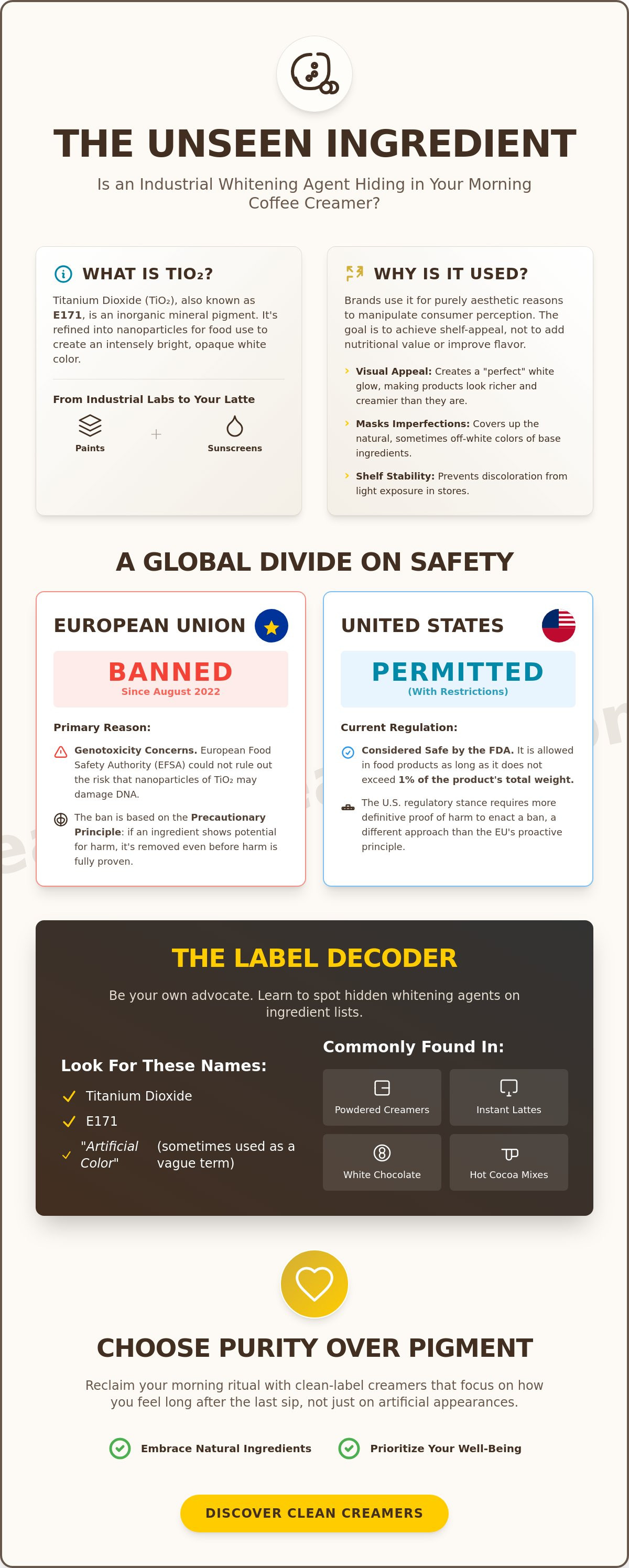
Your morning coffee is a sanctuary. It's a quiet moment for reflection before the day begins. But have you ever paused to look at the color of your creamer? That stark, brilliant white often feels synonymous with "rich" or "creamy." In many cases, that visual perfection is an illusion. It's created by Titanium dioxide (TiO2), an inorganic mineral used as a whitening pigment.
Brands often prioritize this visual appeal over the purity of their ingredients. Why? Because of a deep-seated psychological link. We've been taught to associate bright, opaque liquids with high fat content and luxurious texture. This marketing tactic pushes companies to use additives that don't belong in a healthy diet. You might find this mineral hidden in several common products:
- Powdered coffee creamers
- Instant lattes and cappuccinos
- White chocolate flavorings
- Commercial hot chocolate mixes
As you stir your cup, it's natural to wonder, is titanium dioxide in coffee creamer safe for your daily routine? True creaminess should come from the integrity of the ingredients, not a mineral additive designed for aesthetics. When companies choose industrial pigments, they're choosing shelf-appeal over your long-term wellness.
The Role of E171 in the Food Industry
Commonly labeled as E171, this additive acts like a microscopic prism. It scatters light in every direction to create a dense, opaque white that covers any natural imperfections in the product. It's also incredibly stable. This means it prevents your creamer from losing its color when exposed to light on a store shelf. For powdered products, it provides that "instant" aesthetic that consumers expect. However, this focus on the "perfect look" ignores how your body processes these particles long after the coffee is gone. Your physical state after consumption matters more than the color in the spoon.
Industrial Origins vs. Daily Consumption
The history of this pigment isn't found in a garden. It's found in industrial labs. This same mineral provides the opacity in your house paint and the protective barrier in your sunscreen. To adapt it for food, it's refined into nanoparticles. These tiny particles are the subject of modern safety debates. Understanding if is titanium dioxide in coffee creamer safe requires looking at where these ingredients actually come from. Should an industrial whitener be a recurring guest in your morning ritual? We believe your coffee should support your balance, not disrupt it. Choosing a clean label means choosing a product that values your physical sensation over a manufactured visual.
The Safety Debate: FDA Regulations vs. Global Standards
Why does your morning ritual feel like a point of international debate? It's a valid concern. Depending on where you live, the answer to your question changes. In the United States, the FDA maintains that titanium dioxide is safe for consumption. Their regulation, last amended on May 13, 2026, allows the additive as long as it stays below 1% of the product's weight. But across the Atlantic, the tone is much different. The European Union enacted a total ban on E171 in 2022. This massive divergence leaves many health conscious people asking: is titanium dioxide in coffee creamer safe for my long term wellness?
The core of the conflict lies in genotoxicity. The European Food Safety Authority (EFSA) could not rule out the risk that these particles might damage your DNA. These are not just standard ingredients. They are nanoparticles. Because they are so small, they can potentially bypass your body's natural defenses. While the FDA hasn't found enough evidence to warrant a ban, the uncertainty is enough to make many people pause. You shouldn't have to worry about cellular health while enjoying a latte. Choosing clean label coffee creamers is a simple way to remove that doubt from your kitchen.
Why the US and Europe Disagree
The disagreement comes down to the Precautionary Principle. In Europe, if an ingredient shows a potential for harm, it's often removed before that harm is fully proven. The U.S. and other regions take a different path. For instance, Health Canada's scientific report suggests that current evidence doesn't demonstrate a definitive risk to human health at typical consumption levels. This regulatory lag means your pantry might contain additives that other countries have already left behind. Consumer advocacy is finally catching up. People are demanding more transparency and fewer industrial shortcuts.
Potential Long-Term Health Impacts
Your gut is the foundation of your equilibrium. Recent research into nanoparticles suggests they may trigger intestinal inflammation or disrupt the delicate balance of your microbiome. Some studies even explore how these tiny minerals might accumulate in vital organs over time. Think about how you feel after your morning cup. Do you feel light and energized? Or is there a subtle, lingering heaviness? Purity is a physical sensation. When you prioritize ingredients of natural origin, you aren't just following a trend. You're nurturing your body's natural state of harmony. Trust your intuition. It's often faster than a regulatory update.
The Label Decoder: How to Spot Hidden Whitening Agents
The front of a package is often a work of fiction. Buzzwords like "natural" or "healthy" are designed to create a sense of safety, but they frequently mask industrial shortcuts. To find the truth, you must flip the bottle over. A recent Environmental Working Group report on coffee creamer additives highlights how common these inorganic pigments remain despite growing consumer concern. You deserve clarity. Your body does too.
There is a legal loophole that often leaves consumers in the dark. Manufacturers aren't always required to list the specific mineral by name. Instead, they might use generic terms like "Artificial Color" or "Color Added." If you see these phrases, it's a signal to look closer. It forces you to ask again, is titanium dioxide in coffee creamer safe for your long term wellness? In 2026, a truly clean label is about more than just avoiding "bad" ingredients. It's about the radical transparency of what is actually there.
Common Synonyms for Titanium Dioxide
Industry aliases can be confusing. If you are scanning an international label, look for E171. This is the numeric code used throughout Europe and in many imported products. In other contexts, you might see it listed as Titanium White or Pigment White 6. Even more technical labels might use CI 77891, which is the Color Index number often found in cosmetics but occasionally used in food processing. These names all point back to the same industrial whitener. Recognizing these terms is the first step toward reclaiming your morning ritual. Knowledge is your best defense.
The Checklist for a Truly Clean Creamer
Finding a creamer that supports your equilibrium doesn't have to be a chore. Start by prioritizing short ingredient lists. You should recognize every item as a plant based origin or a functional nutrient. Look for specific "No Artificial Colors" certifications that go beyond basic marketing claims. When you choose healthy coffee creamers, you are investing in a product that values transparency over aesthetics. Your coffee should be a source of restoration. Ensure your ingredients reflect that same intention. Purity you can feel. That is the ultimate goal.
Choosing Transparency: Reimagining the Morning Ritual
Why do we demand that our coffee creamer be as white as fresh snow? For decades, industrial marketing has convinced us that whiteness equals quality. It's time to unlearn that myth. Moving from a mindset of clinical restriction to one of mindful abundance means accepting that real ingredients have their own unique character. The natural color of plant-based fats is often a soft ivory or a warm cream. This "off-white" aesthetic isn't a flaw. It's a badge of purity. It's a sign of integrity.
When you stop worrying about whether is titanium dioxide in coffee creamer safe, you open the door to a more authentic morning ritual. True creaminess comes from the physical interaction of healthy fats and hot coffee, not from an industrial mineral designed for paint. This shift in perspective allows you to prioritize how your body feels an hour after your cup is empty. Ingredient integrity leads to sustained energy. It avoids the heavy, sluggish feeling often associated with processed additives. You deserve a morning that fuels you, not one that weighs you down.
The Power of Plant-Based Functionality
Coconut oil and MCTs are the heroes of a modern, clean label. These functional fats provide the mouthfeel you crave while serving your body's energy needs. Powdered formats are particularly effective here. They allow for a high concentration of these healthy fats without the need for the liquid preservatives or stabilizers found in many bottled versions. Joining the dairy free creamer revolution doesn't mean sacrificing flavor. It means choosing flavor that aligns with your equilibrium.
- Coconut Oil: Provides a velvety texture and natural sweetness.
- MCTs: Support cognitive function and steady energy.
- Clean Label Integrity: No hidden dyes or industrial bleaches.
Mindful Consumption Habits
Creating a ritual that aligns with your wellness goals starts with asking "Why?" before you stir. Why am I choosing this ingredient? How will it make me feel? Focus on the physical sensation of lightness. A clean creamer should leave you feeling refreshed and ready for the day, not bogged down by industrial shortcuts. As you refine your routine, the question of whether is titanium dioxide in coffee creamer safe becomes less about fear and more about choice. This intentionality transforms a simple habit into a meaningful practice of self-care. It's about finding harmony in the small things.
Ready to experience a ritual that prioritizes your well-being? Explore our collection of clean label coffee creamers today.
Leaner Creamer: Purity You Can Feel
You've navigated the complex world of global regulations and decoded the hidden aliases on ingredient labels. Now comes the most rewarding part of your journey: choosing a ritual that chooses you back. At Leaner Creamer, our commitment hasn't wavered. We've maintained a strict "No-Titanium" philosophy since our inception in 2015. While global markets only recently began debating if is titanium dioxide in coffee creamer safe, we've always believed that industrial pigments have no place in your cup. Purity isn't a trend for us. It's our foundation.
We achieve that signature velvety texture through the power of nature. By utilizing functional, plant based fats, we provide a rich experience that doesn't rely on artificial whitening agents. Our formulas are intentionally simple. No soy. No gluten. No artificial dyes. We focus on providing glucose friendly coffee creamers because we know that balanced energy is the key to a productive day. It's about how you feel long after the last drop is gone. Purity. Period.
Ingredient Integrity as a Lifestyle
Our powders focus on what truly matters: healthy fats and natural flavor. We prioritize ingredients like coconut oil and MCT oil to give your body a mindful energy boost. We don't hide behind generic labels. You deserve to know exactly what is fueling your morning. This integrity is what creates the physical sensation of lightness and clarity that our community loves. It's a small, manageable improvement to your daily habit that yields lasting results for your well-being. When you ask if is titanium dioxide in coffee creamer safe, the answer becomes clear when you experience the alternative.
Start Your Mindful Morning
Transitioning to a cleaner cup doesn't mean losing the flavor you love. It means elevating it. Our community chooses a lifestyle of equilibrium. They understand that a morning routine is more than a functional act. It's a practice of self-care. When you remove industrial shortcuts, you make room for real restoration. You can enjoy your coffee with total confidence, knowing your creamer supports your long term wellness goals. It's time to feel as good as your coffee tastes.
Experience the clean-label difference with Leaner Creamer.
Reclaiming Your Morning Harmony
Your journey toward a cleaner ritual starts with a single, intentional choice. We've explored the complex global debate and the hidden aliases of industrial pigments. While regulatory bodies continue to discuss if is titanium dioxide in coffee creamer safe, you don't have to wait for a final verdict to prioritize your well-being. True creaminess is born from the integrity of natural fats, not the artificial glow of a mineral additive. It's about how you feel long after the steam has vanished from your cup. Purity is a physical sensation.
Choosing a path of transparency means embracing ingredients that support your body's natural state of equilibrium. You deserve a morning that feels as good as it tastes. Our commitment to integrity ensures you never have to compromise on your wellness goals. Ready to transform your daily habit into a practice of restoration? Elevate your ritual with our TiO2-free coffee creamers. Our blends are Keto Certified, Sugar-Free & Glucose Friendly, and contain No Artificial Colors or Dyes. Mindful energy. Pure restoration. It's all within reach. Your best morning is waiting for you.
Frequently Asked Questions
Is titanium dioxide banned in the United States?
No, titanium dioxide is not currently banned in the United States. The FDA permits its use as a color additive at a concentration not to exceed 1% of the finished product's weight. While the European Union enacted a total ban in 2022, U.S. regulations remain unchanged as of May 2026. This regulatory divergence is why many people still ask, is titanium dioxide in coffee creamer safe for their daily wellness goals.
What happens if I consume titanium dioxide in my coffee every day?
Daily consumption means you are regularly ingesting nanoparticles that the body may struggle to process over time. While the FDA considers it safe at low levels, the European Food Safety Authority raised concerns about its potential to accumulate in vital organs. These industrial pigments might impact your gut microbiome or trigger subtle, long term inflammation. Choosing a clean label ensures your morning habit supports your lasting physical state.
Does "natural" coffee creamer contain titanium dioxide?
It is possible. The term "natural" on a label isn't a legal guarantee that a product is free from industrial whiteners or pigments. Manufacturers sometimes use titanium dioxide to ensure a consistent, bright appearance even in products marketed as healthy. To be certain, you must look beyond the front of the package. Scan the ingredient list for E171, Pigment White 6, or generic terms like color added.
Is titanium dioxide the same as the stuff in sunscreen?
Yes, it is the same mineral used to provide opacity in sunscreen and industrial paint. In food, it is refined into a food-grade version often referred to as E171. While it serves a functional purpose in sun protection by blocking UV rays, its role in your creamer is purely aesthetic. This industrial origin is a major reason why many wellness-conscious people seek out cleaner, plant based alternatives.
Can titanium dioxide cause inflammation in the gut?
Recent research suggests a potential link between titanium dioxide nanoparticles and intestinal inflammation. Because these particles are so small, they can interact with the delicate lining of your digestive tract and disrupt the balance of your microbiome. This may lead to a lingering sense of heaviness after your cup. If you prioritize how you feel after consumption, avoiding these additives is a mindful step toward gut health.
Why do companies use titanium dioxide if there are safety concerns?
Companies primarily use it to create a "perfect" opaque white that consumers associate with richness and creaminess. It also helps prevent color degradation when the product is exposed to light on store shelves. It is a cost effective way to maintain a specific visual appeal. However, this focus on marketing often comes at the expense of ingredient purity. Purity should always be more important than a manufactured aesthetic.
How can I tell if my creamer is truly clean-label?
A truly clean label features a short list of recognizable, plant based origins. You should see functional ingredients like coconut oil or MCTs rather than numeric codes or industrial pigments. Look for specific certifications like Keto Certified or Sugar-Free. This transparency is the best way to determine if titanium dioxide in coffee creamer safe for your specific goals. True quality doesn't need to hide behind generic terms.
Are there safe alternatives to titanium dioxide for whitening coffee?
Yes, nature provides beautiful alternatives that nourish the body. Healthy fats like coconut oil and MCTs create a natural, velvety texture and a soft ivory color. Some manufacturers are also exploring cellulose-based agents as whitening substitutes. These options prioritize your physical sensation and long term wellness over industrial shortcuts. You can achieve a luxurious cup using only functional, mindful ingredients that support your daily equilibrium.


